Austin has both foundation types, and each has distinct failure modes. Learn the repair process, costs, and warning signs for each.
Austin has both foundation types in significant numbers. Slab foundations dominate post-1960 construction — the ranch-style and contemporary homes that make up most of Austin's suburban neighborhoods. Pier and beam foundations are found in the city's older, established neighborhoods: Hyde Park, Bouldin Creek, Clarksville, Travis Heights, and the historic east side.
Both types fail in Austin's clay soil, but they fail differently. The repair process, cost, and timeline differ significantly between them.
Slab foundations: how they work and how they fail
A slab foundation is a single monolithic concrete pad that serves as both the foundation and the finished floor. It's cast on grade (directly on the soil), typically 4–6 inches thick, with reinforcement running through it. Post-tension slabs — the standard since the 1980s — add steel cables under tension to pre-compress the concrete, making it more resistant to cracking.
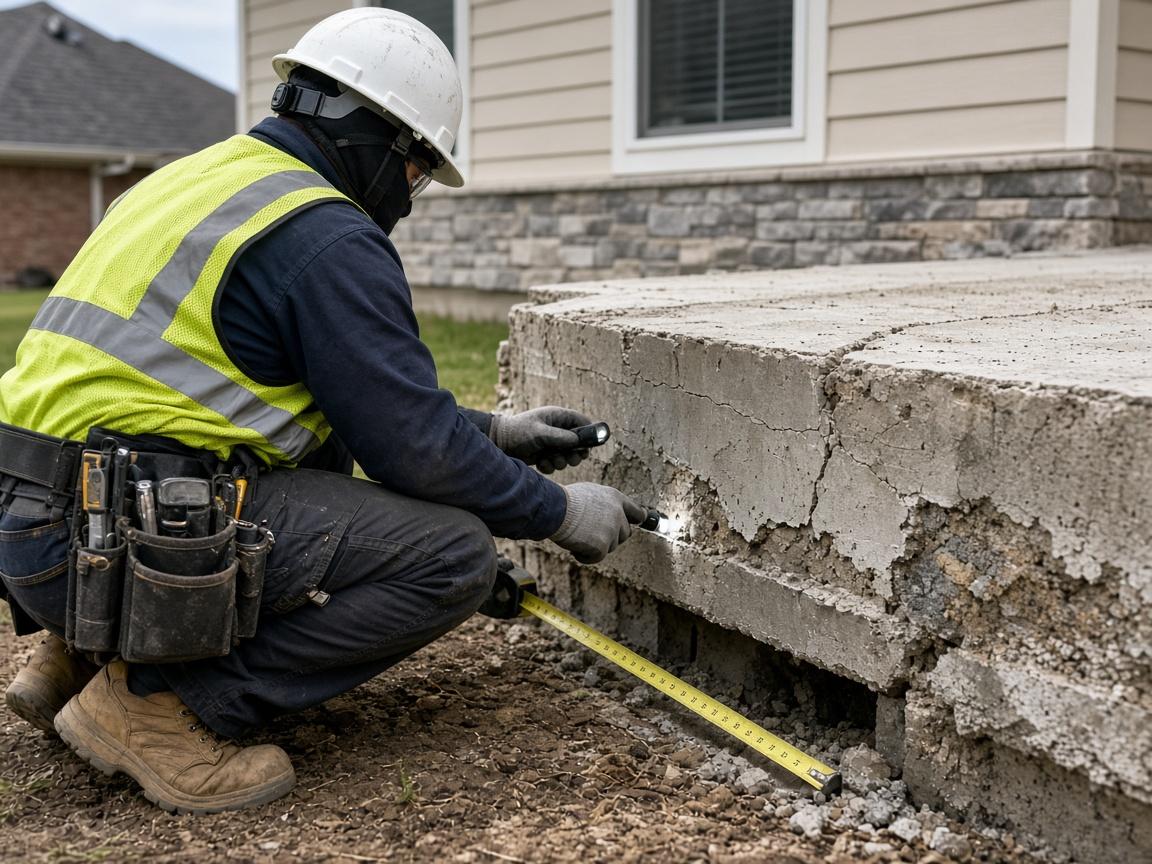
Slabs fail when differential soil movement exceeds what the concrete can bridge. As the clay beneath one section of the slab dries and shrinks, that section loses support. If the drop is gradual, the slab flexes; if it's sudden or large, it cracks. The classic failure mode is edge settlement — the perimeter of the slab drops while the center holds, creating diagonal cracks at structural openings and stair-step cracking in the brick veneer.
Pier and beam foundations: how they work and how they fail
Pier and beam foundations elevate the structure above grade on a grid of concrete or masonry piers, with wood beams spanning between piers and a wood subfloor on top. The crawl space between the ground and the floor provides access to utilities and allows the structure to adjust to soil movement — the individual piers can settle at different rates without cracking a monolithic slab.
Pier and beam systems fail in two distinct ways: settlement and moisture damage. Settlement occurs as individual piers move — typically because they were set in the active clay zone rather than deep stable soil. As the clay moves seasonally, piers rock and tilt, causing floors to bounce and slope. Moisture damage occurs in the crawl space — Austin's humidity causes wood rot in insufficiently protected floor systems over decades.
Repair comparison
Slab repair requires pier installation through the exterior beam (and sometimes through interior core holes) to reach stable soil. No access to the underside of the slab is possible — all work is from the exterior. Interior repairs require cutting holes in the slab. The repair is more invasive for interior settlement, but faster and cleaner for perimeter settlement.
Pier and beam repair allows direct access to the underside of the structure — a significant advantage. Individual piers and beams can be assessed and replaced without disturbing others. The repair is highly targetable: we fix the piers that have settled and the beams that have failed, leaving the rest alone. The trade-off is that crawl space work is physically demanding and unpleasant — it's dirty, dark, and tight.
Which is more expensive to repair?
Per-incident, slab repairs tend to cost more because they require heavier equipment and more extensive site preparation. But pier and beam systems often require more frequent repairs because the wood members have a finite lifespan and the individual piers were often set to inadequate depth. Over a 30-year ownership window, the repair costs of pier and beam and slab systems in Austin are roughly comparable for typical older homes.
Foundation Specialists — Austin, TX