Helical Pier Foundation Repair in Austin
Deep, load-bearing helical piers anchored below Austin's expansive clay layer for permanent stability.
About This Service
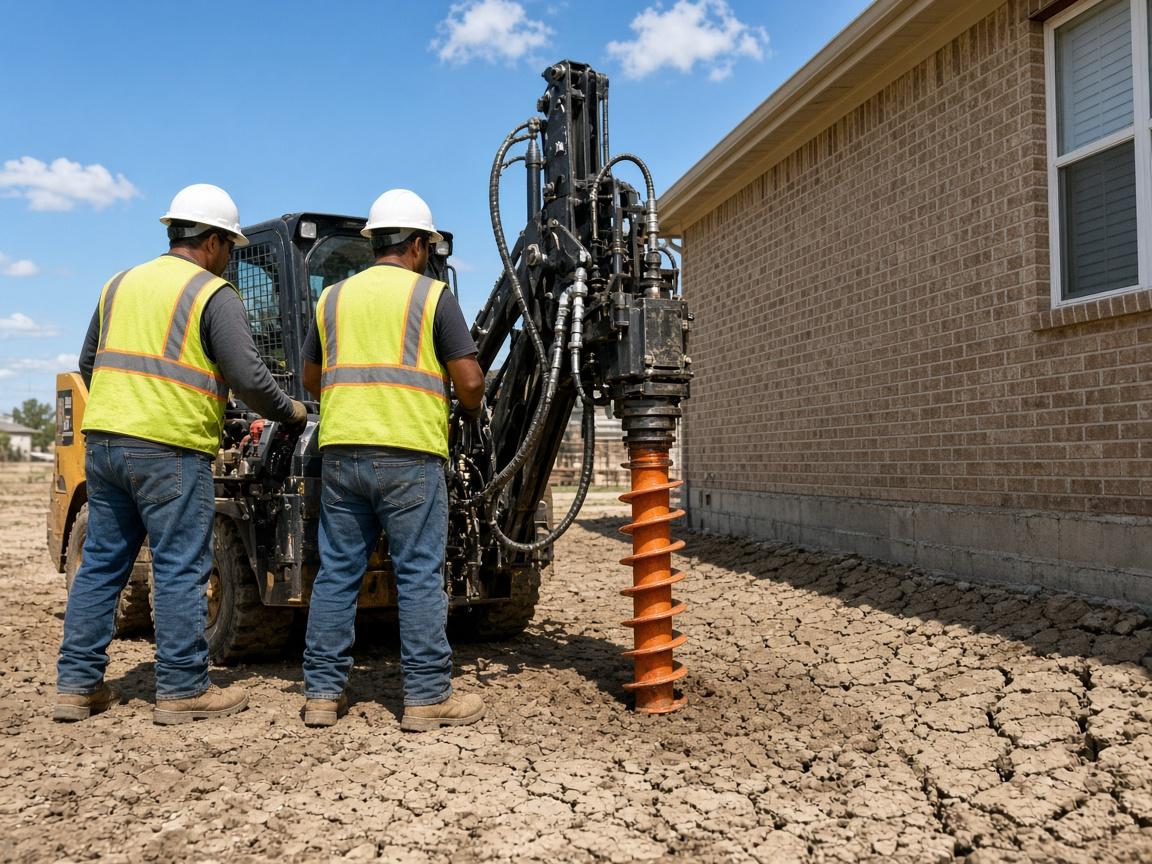
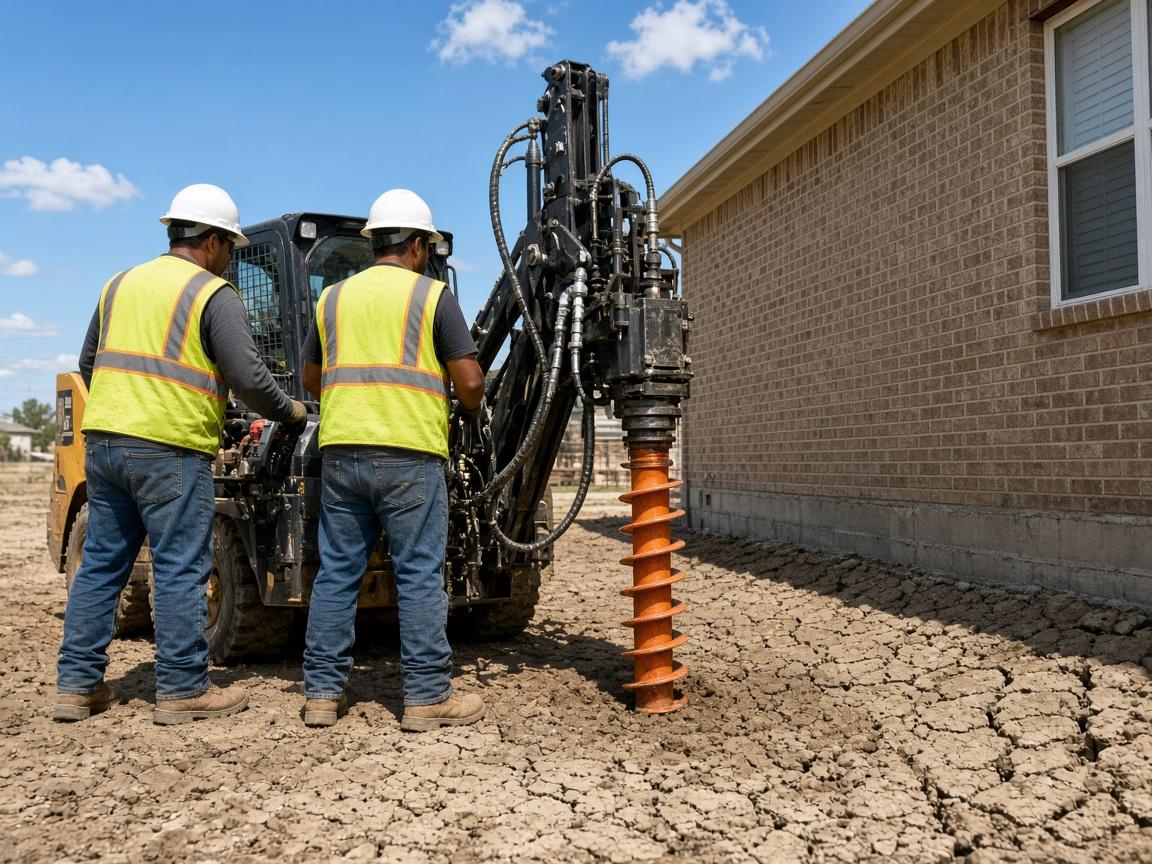
Helical piers — also called helical piles or screw piles — are steel shafts with one or more helix-shaped bearing plates welded to the shaft. They're installed by rotating them into the soil using a hydraulic torque motor, much like a giant screw going into wood. As the helical plates advance through the soil, they displace soil horizontally rather than pushing it down, creating minimal vibration and no spoil removal.
For Austin foundation repair, helical piers offer distinct advantages in specific situations: limited equipment access, structures with lighter loads, locations near existing utilities, and new construction underpinning where a post-tension slab prevents interior pier installation.
Why This Happens in Austin
Helical piers shine where conventional push piers can't go. Push piers require hydraulic driving equipment that transfers reaction force through the structure — meaning the building's own weight resists the driving force. For light structures (additions, sunrooms, small outbuildings), there may not be enough dead load to drive push piers effectively. Helical piers create their own resistance through soil-helix friction, so they work regardless of how light the structure above is.
In Austin's tight urban lots — particularly in Hyde Park, East Austin, and Mueller — helical piers installed with a mini skid-steer or hand-operated torque head can access locations that large equipment simply can't reach. And because helical piers provide immediate load capacity (no curing time), repair timelines are shorter.
How the Repair Process Works
- 1Helix selection: We select the helix diameter and shaft size based on the required load capacity and the soil conditions at your site. Larger helices in weaker soils, smaller helices in dense clay or near-limestone conditions.
- 2Torque monitoring: As the pier is installed, a calibrated torque meter monitors installation torque in real time. There's a direct correlation between final installation torque and load capacity — this is how we verify each pier is adequate without a separate load test.
- 3Depth to bearing: Helical piers are advanced until the torque reading confirms adequate bearing strata has been reached. In Austin, this is typically the Austin chalk formation or dense sub-strata below the active clay zone.
- 4Bracket attachment: After installation, a load-transfer bracket is hydraulically pressed to the foundation and bolted to the pier shaft. This bracket carries the foundation load directly to the pier.
- 5Lift and lock: Hydraulic jacks at each pier position simultaneously lift the settled foundation to target elevation. The brackets are then locked at that position.
- 6Torque correlation report: Each pier installation is documented with torque readings, installation depth, and calculated capacity — forming the engineering basis for any transferable warranty.
Warning Signs You Need This Repair
- Settlement in an addition, garage, or sunroom that was added to the original structure
- Settlement near a utility trench or previous excavation where soil was disturbed
- A structure with limited yard access where heavy equipment can't reach
- New construction that has settled within 1–5 years of being built
- Interior settlement requiring pier access through a post-tension slab
Austin Soil Context
Austin chalk — a soft limestone formation — provides excellent helical pier bearing capacity across much of Austin's subsurface. When encountered at depth, helical piers tip into Austin chalk and achieve capacity quickly. In areas where Austin chalk is deeper or absent, helical piers are advanced into the dense Buda Limestone or Del Rio Clay formations that underlie the chalk.
Frequently Asked Questions
How deep do helical piers go in Austin?
Most helical piers in Austin reach 10–18 feet to hit the Austin chalk or dense sub-clay strata. In areas with deeper chalk (west Austin hill country), depths of 20–25 feet are not uncommon. Each pier is advanced until torque confirms adequate bearing — the final depth is determined by field conditions, not a fixed plan.
Are helical piers as strong as push piers?
Per-pier, push piers typically have higher load capacity because they're driven to absolute refusal in rock or very dense strata. But helical piers offer more precise capacity control (verified via torque), and for typical residential loads in Austin, helical piers provide more than adequate capacity with a comfortable safety factor.
Can helical piers be installed inside a home?
Yes — with a compact-head torque motor, helical piers can be installed through core holes in an interior slab. The equipment is small enough to work inside a typical residential space. This is particularly useful when interior settlement requires correction without full exterior excavation.
Austin Foundation Repair Pros serves Austin and 14 surrounding communities with licensed foundation repair crews. Every repair starts with a free written assessment — no pressure, no surprises, no upselling.
Get a Free Estimate
Tell us what you're seeing. We'll schedule a free on-site inspection and give you a written diagnosis.
Request Estimate Online (512) 601-5288What You Get
- No spoil removal — helices displace soil rather than excavating it
- Immediate load capacity — no concrete curing time
- Works in limited-access locations where push pier equipment can't reach
- Effective for light structures where dead load is insufficient for push pier reaction
- Precise load capacity verification via torque monitoring
Service Area
Austin and surrounding communities including Round Rock, Cedar Park, Pflugerville, Georgetown, Leander, Kyle, Buda, Hutto, Lakeway, Dripping Springs, San Marcos, Bastrop, Manor, and Bee Cave.