Drainage Solutions & French Drains in Austin
Poor drainage destroys foundations — proper water management protects your biggest investment.
About This Service
Drainage solutions are the most underrated component of foundation protection in Austin. Piers stop the damage that's already occurred. Proper drainage stops more damage from accumulating. And in many cases, fixing drainage alone — without any pier work — is all that's needed to stop the progression of a foundation problem.
The connection between drainage and foundation health in Austin is direct: the city's heavy clay soil is nearly impermeable when dry. During a rainstorm, water doesn't soak in — it runs. When it runs toward your house instead of away from it, it ponds against the foundation. That ponding saturates the clay immediately adjacent to the foundation edge. The hydrating clay expands, pushing against the foundation edge. Then when it dries out, it shrinks away, leaving a gap. Over years, that cycle creates a moat of loose, movement-prone soil right where your foundation needs the most stable support.
Why This Happens in Austin
Austin's annual rain distribution creates perfect conditions for foundation-damaging drainage. Seventy percent of Austin's annual rainfall arrives in spring (March–June) and fall (September–October) as intense, short-duration storms. The clay soil can't absorb fast enough, so water runs. If your yard grading, gutters, and landscape features aren't actively directing that water away from the foundation, it will find its own path — and that path usually runs along the foundation edge.
The secondary drainage problem is tree root intrusion. Austin's live oaks and cedar elms are aggressive water-seekers. Root systems extend 2–3 times the canopy radius underground, and they follow moisture gradients — meaning they grow toward wherever water concentrates. If water concentrates against your foundation, root systems follow — compounding the drainage problem with biological soil disturbance.
How the Repair Process Works
- 1Drainage assessment: We walk your property during or after a rain event (or use hose simulation) to trace where water flows, where it ponds, and where it enters the soil near your foundation.
- 2Grade analysis: We measure the slope of landscaped areas adjacent to the foundation. The IRC standard is a minimum 6-inch drop over the first 10 feet from the foundation. Most problem properties are flat or negative-slope within this zone.
- 3Gutter and downspout audit: We check downspout discharge locations and verify extensions are carrying water at least 6 feet from the foundation. Splash blocks erode; flexible extensions kink; underground connections fail. We find what's not working.
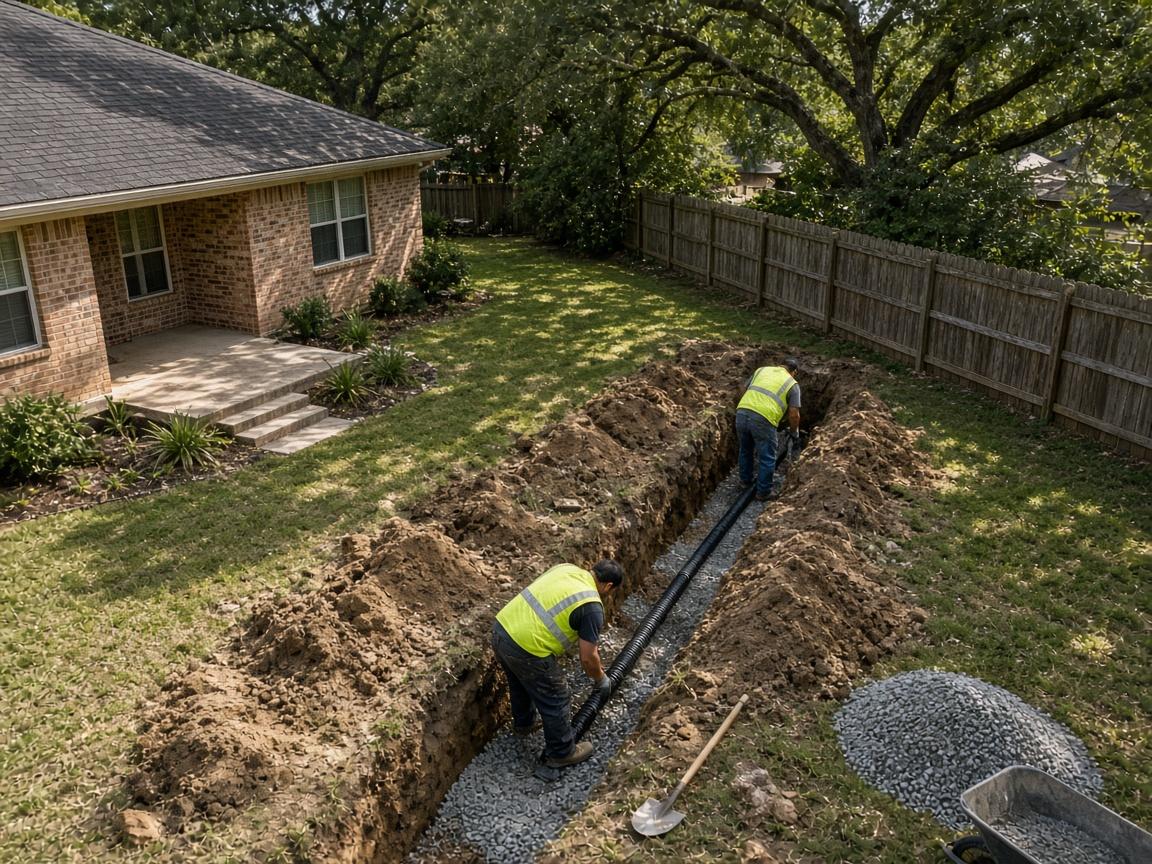
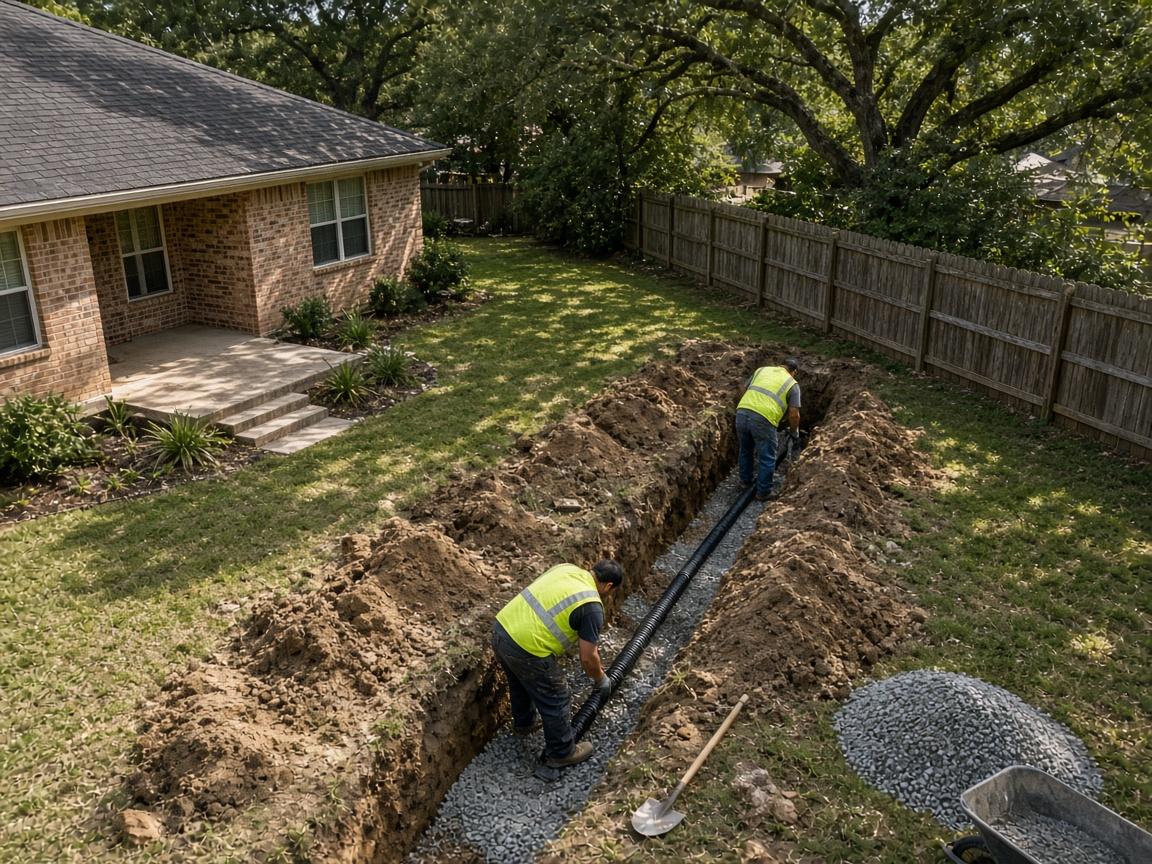
- 4French drain design: For areas where surface grading can't be corrected, we design subsurface French drain systems — perforated pipe in gravel-wrapped trenches that intercept groundwater moving toward the foundation and redirect it to a safe discharge point.
- 5Channel drain installation: For patios, driveways, and other hardscaped surfaces adjacent to the foundation, linear channel drains capture surface water before it can reach the foundation edge.
- 6Grading correction: Where possible, we recommend and coordinate soil and mulch grading corrections to re-establish positive slope away from the foundation.
Warning Signs You Need This Repair
- Water visible against the foundation after any rain over 0.5 inches
- Gutters discharging within 3 feet of the foundation
- Yard that slopes toward the house rather than away from it
- Downspouts that terminate at a splash block adjacent to the foundation
- Basement or crawl space that takes on moisture after rain
- Foundation that settles faster on one side — often the low drainage side
Austin Soil Context
French drains in Austin clay soil require a specific design approach. Standard sock-wrapped perforated pipe can clog quickly in fine-grained clay. We use non-woven geotextile filter fabric around the gravel trench, sized appropriately for the clay particle size. Outlet discharge elevation and location matter — in Austin's frequent drought, subsurface drainage systems occasionally need cleanout to remain functional.
Frequently Asked Questions
Do I need French drains or just better gutters?
Sometimes gutters alone solve the problem. If your downspouts are discharging near the foundation and the yard is otherwise well-drained, extending your downspouts 6–8 feet with a flexible extension might be all you need. We'll tell you the honest answer — not the most expensive one.
How long does French drain installation take?
A typical residential French drain system takes 1–2 days. Larger systems (multiple drainage zones, significant distances to discharge points) can take 3–4 days. We hand-dig near the foundation to avoid utilities, and use machine trenching in open yard areas.
Will French drains hurt my landscaping?
Trenching disturbs the surface along the drain path. We backfill with excavated soil and compact, but there will be a visible trench line for a season while soil settles and vegetation re-establishes. Sod patches or seed over the disturbed area typically recover within one growing season.
Can you drain a crawl space that floods?
Yes. A combination of interior drain tile (around the crawl space perimeter), a sump pit, and exterior French drainage can convert a wet crawl space to a dry one. Combined with vapor barrier installation, this significantly reduces wood rot risk in pier and beam homes.
Austin Foundation Repair Pros serves Austin and 14 surrounding communities with licensed foundation repair crews. Every repair starts with a free written assessment — no pressure, no surprises, no upselling.
Get a Free Estimate
Tell us what you're seeing. We'll schedule a free on-site inspection and give you a written diagnosis.
Request Estimate Online (512) 601-5288What You Get
- Stops new moisture loading of foundation-adjacent soil — breaks the wet-dry cycle
- Slows or stops active foundation settlement caused by drainage failure
- Reduces hydrostatic pressure on foundation walls and crawl space areas
- Protects landscaping investment from erosion and waterlogging
- Extends the life of prior foundation pier repair by eliminating the driver of future movement
Service Area
Austin and surrounding communities including Round Rock, Cedar Park, Pflugerville, Georgetown, Leander, Kyle, Buda, Hutto, Lakeway, Dripping Springs, San Marcos, Bastrop, Manor, and Bee Cave.