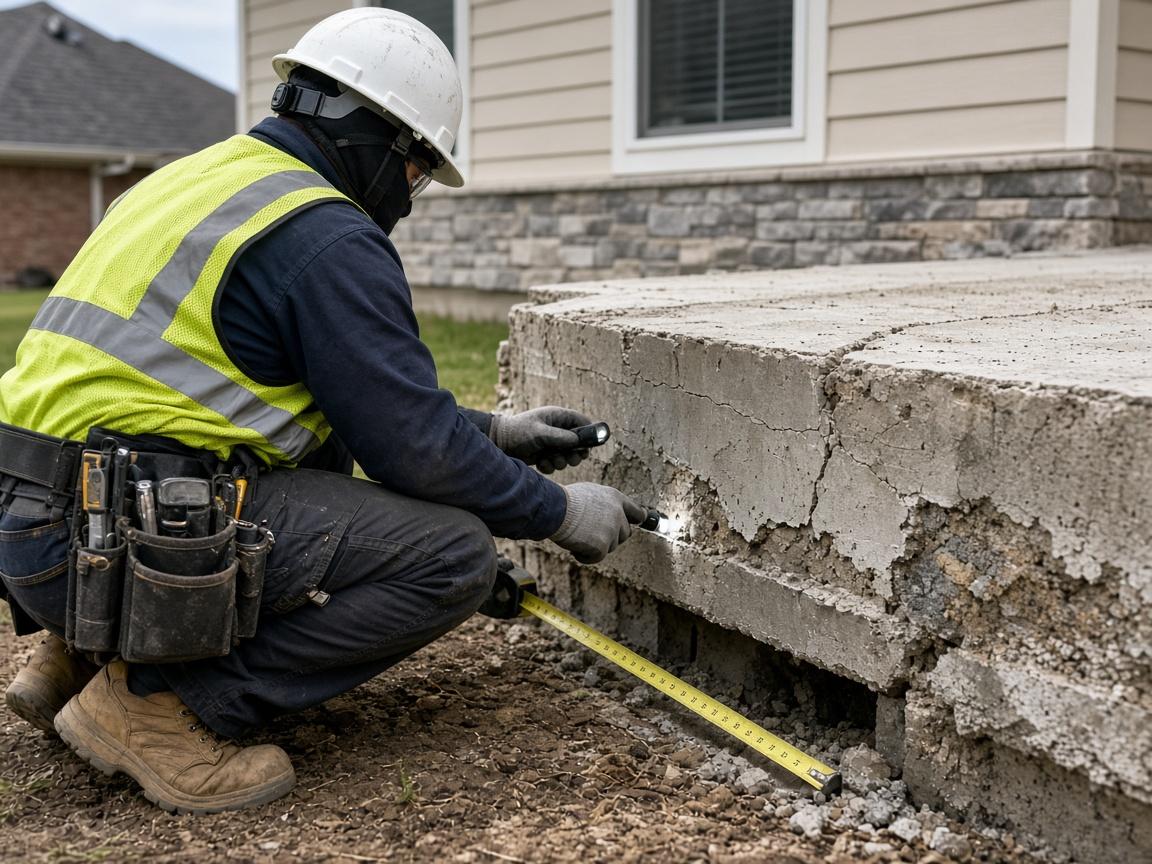
The Blackland Prairie clay under most Austin homes is among the most expansive soil in the US. Here's how it moves, why it cracks slabs, and how proper drainage slows the damage.
Austin sits in the middle of the Texas Blackland Prairie — a belt of highly expansive clay soil that runs from Dallas to San Antonio. This clay is exceptional in the worst possible way for building foundations: it's among the most reactive expansive soil in North America.
Understanding what this soil does, and why, is the starting point for managing foundation damage in Austin. This isn't a problem that can be engineered away — it can only be managed intelligently.
The chemistry of expansive clay
Austin's predominant clay mineral is montmorillonite — a member of the smectite clay family. Montmorillonite is a layered aluminosilicate mineral with a remarkable ability to absorb water molecules between its molecular layers, causing the entire crystal structure to expand. Under wet conditions, Austin clay can absorb enough water to increase its volume by 30–50%. Under drought conditions, it releases that water and shrinks back — sometimes to the point of cracking visibly at the surface.
The COLE index (Coefficient of Linear Extensibility) measures how much a soil shrinks between field-moist and oven-dry conditions. Austin's Blackland Prairie soils have COLE values of 0.09–0.15. Anything above 0.06 is classified as 'high' by USDA standards. Austin's clay routinely measures two to three times that threshold.
How clay movement damages foundations
The problem isn't that the clay moves — it's that it moves unevenly. The soil under the perimeter of your slab (exposed to evaporation and temperature change) dries faster than the soil under the center. The exposed edges shrink more than the center. The slab edges lose support; the center retains it. The slab flexes, and concrete — which handles compression well but handles tension poorly — cracks along the tension zones.
The classic Austin failure pattern is edge settlement with center upheaval: the perimeter of the slab drops while the center holds or even rises (the classic 'doming' pattern). This creates the familiar symptom cluster: sticking doors near the perimeter, stair-step brick cracking at corners, and floor slopes that run from the center of the home toward the edges.
The drought-flood cycle
Austin's dramatic wet-dry seasonal cycle amplifies clay damage. A severe drought year — 2022 was particularly bad — dries the clay to unusual depth. When rain eventually returns (often as intense storms), the clay rehydrates rapidly and unevenly. Soil adjacent to the foundation that was bone-dry in July absorbs the October rains and expands. But expansion after severe drought often causes upheaval rather than simple rehydration — the soil that had compacted during drought pushes back harder than it settled.
What actually works to slow the damage
Three things reliably reduce clay-driven foundation movement in Austin: drainage improvement (keeping water away from the foundation so wet-dry cycles at the foundation edge are less extreme), consistent foundation watering during drought (using a soaker hose along the perimeter to maintain moisture uniformity), and deep pier installation that bypasses the active zone entirely.
Of these, drainage improvement is the most preventive. A properly graded yard that directs water away from the foundation — combined with extended downspouts and vegetation that doesn't concentrate moisture at the foundation edge — significantly reduces the amplitude of the wet-dry cycle at the critical foundation perimeter zone.
Deep pier installation doesn't stop the clay from moving — it transfers the foundation load to soil that's below the movement zone. The clay above the pier tips still moves, but the load is carried by stable material below. That's why pier installation that doesn't reach adequate depth fails: if the pier tip is still in the active clay zone, the pier moves with the clay.
Foundation Specialists — Austin, TX